John 10:31-42 NASBSThe Jews picked up stones again to stone Him. [32] Jesus answered them, “I showed you many good works from the Father; for which of them are you stoning Me?” [33] The Jews answered Him, “For a good work we do not stone You, but for blasphemy; and because You, being a man, make Yourself out to be God.” [34] Jesus answered them, “Has it not been written in your Law, ‘I SAID, YOU ARE GODS’? [35] If he called them gods, to whom the word of God came (and the Scripture cannot be broken), [36] do you say of Him, whom the Father sanctified and sent into the world, ‘You are blaspheming,’ because I said, ‘I am the Son of God’? [37] If I do not do the works of My Father, do not believe Me; [38] but if I do them, though you do not believe Me, believe the works, so that you may know and understand that the Father is in Me, and I in the Father.” [39] Therefore they were seeking again to seize Him, and He eluded their grasp. [40] And He went away again beyond the Jordan to the place where John was first baptizing, and He was staying there. [41] Many came to Him and were saying, “While John performed no sign, yet everything John said about this man was true.” [42] Many believed in Him there.
This is a scene in the life of Jesus that should stop our hearts every single time we read it, yet it often goes unnoticed. It is the jarring, scandalous image of the Maker of the Universe making an escape. The King of Glory—the one whose voice sustained the atoms of the universe and ordained “Let there be Light”—is suddenly making a run for His life, searching for a place of safety.
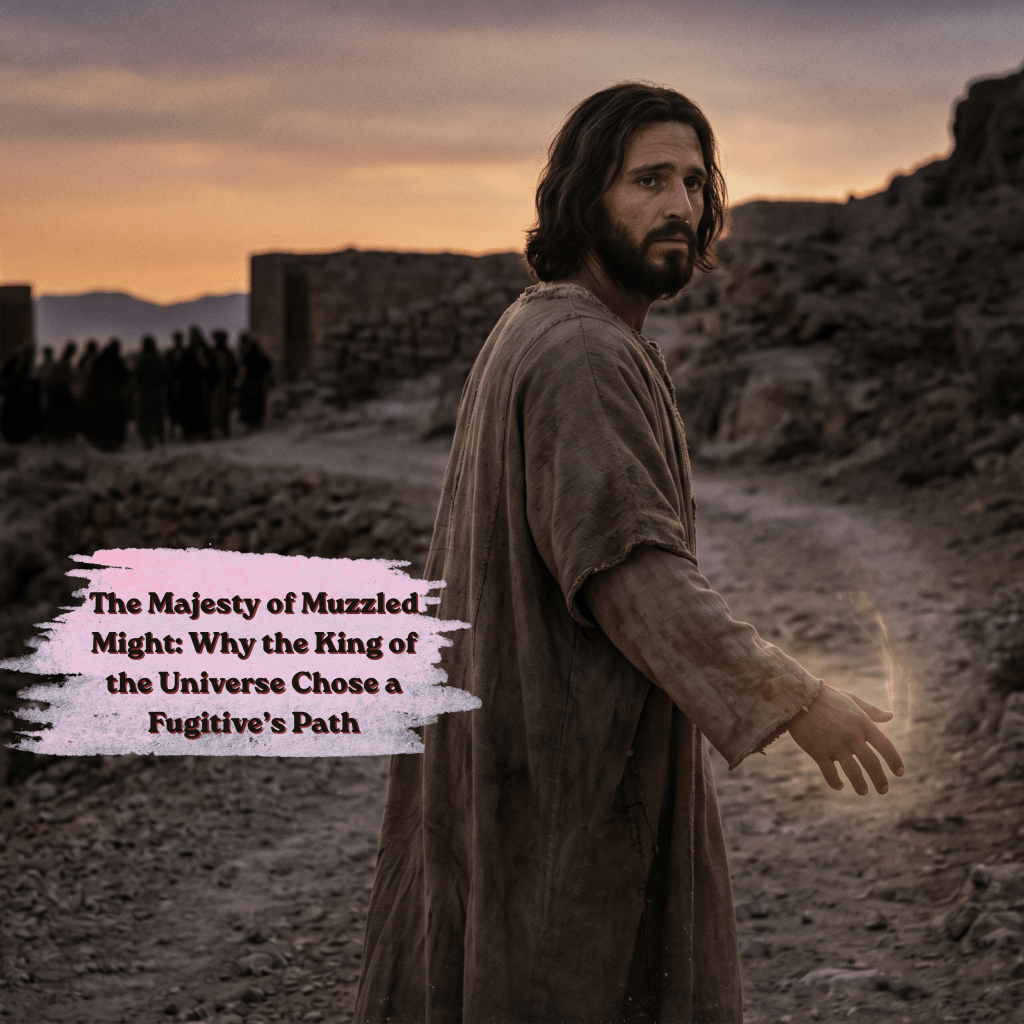
Is this serious? The very people He came primarily to save are the ones taking up stones to kill Him. If you have ever experienced betrayal, rejection, or a crushing lack of gratitude, you know the tremendous amount of pain and disappointment that follows. They tried to stone Him by force—how ungrateful! Jesus made an escape to the desert, returning to the place where John once baptized, seeking a momentary place of safety among those who actually affirmed His ministry.
To the world, this looks like a collapse, a complete failure of a person without the capacity to walk in triumph before His enemies. But look closer. This isn’t a failure of power; it is the most robust exercise of divine restraint in the history of the Universe. It is the majesty of muzzled might—the Almighty God choosing not to use the very power that sustains all things.
The King Who Borrowed Everything
We often struggle to grasp the paradox of Kenosis—the self-emptying of Christ. Let’s be clear: Jesus didn’t “lose” His divinity; He voluntarily restrained the independent use of it. He muzzled His omnipotence so that He could experience, in full, the limitations and frustrations of our human fragility.
Think about the sheer, staggering humility of this: The one who owns the cattle on a thousand hills spent His life as a guest. He chose to embrace a borrowed manger to be born in, a borrowed boat to preach from, an animal that wasn’t His to ride, and a borrowed room for the Passover. He was the only person who ever lived on Earth with a legal right to everything on it, yet He ended up with nothing.
This wasn’t just a “feeling” of poverty; it was a reality in which He made Himself poor so we could access the full inheritance as children of God. It was an act of self-substitution—God paying the debt we owed through His refusal to use His divine power for His own benefit.
The Power of Refusal in the Garden
Nowhere is this power of refusal more evident than in the Garden of Gethsemane. Before the mob arrived, Jesus was on His knees, bleeding through His sweat glands in complete anguish, asking if the terrible cup could be avoided. But His answer was a conscious surrender: “May your will be done, not mine”.
When the torches and swords finally appeared, Peter did what any of us would do—he swung. But Jesus did something radical. He rebuked the violence and healed the very ear of the man who came to arrest Him. In that moment, as Peter was stopped, Jesus revealed the “veiled majesty” behind His restraint:
“Do you think that I cannot now pray to My Father, and He will provide Me with more than twelve legions of angels?”
Understand this: Jesus wasn’t trapped. He wasn’t a victim of a clever political plot or the betrayal of a friend. He was the Master of the moment, exercising an authority that chooses to serve rather than dominate. History is full of stories of kings who asked their people to die for them; Jesus is the only King who used His power to die for His subjects. His restraint was chosen because His redemptive mission transcended His personal safety.
The Great Forensic Exchange
Why the “escape” and the “fragility”? It was for the sake of a radical reversal of fortune—the heart of substitutionary atonement. On the cross, Jesus wasn’t just sympathizing with our condition; He was doing a legal business of exchange.
This is the great forensic exchange: He took our infinite debt and gave us His infinite worth. Our sins were imputed to Him, and His righteousness was imputed to us. Justice was not bypassed; it was fulfilled as the penal retribution we earned was absorbed into His own body. He became a curse for us so the cycle of death could finally be broken.
“But he was wounded for our transgressions, he was bruised for our iniquities; upon him was the chastisement that made us whole, and with his stripes we are healed.” (Isaiah 53:5)
Shattering the Retribution Loop
Finally, we see the ultimate aim of this divine restraint in His final cry: “Father, forgive them, for they know not what they do.” In that single sentence, Jesus shattered the cycle of retribution that has haunted humanity since Eden.
He refused to mirror the behavior of His oppressors. Rather than meeting violence with counter-violence, He absorbed the full weight of human sin and divine justice simultaneously. This wasn’t “cheap grace”—it was costly grace, the most expensive gift in existence. By absorbing the consequences we deserved, He eliminated the basis for perpetual retribution and showed us a “creative agency” that transforms oppression rather than just submitting to it.
A Pastoral Call to the Scars
When life leaves you feeling fragile—when you feel like a fugitive in your own story—remember the King who ran. His fragility was a mask for a strength that could move mountains but chose to carry a cross instead.
He denied the “normal human way” of frustration and anger to choose the Father’s path. He took what we deserved so we could have what He possessed. He ran, so that you would never have to run from God again.
This is the scandal. This is the beauty. This is the absolute, unshakeable power of the Gospel.

Leave a comment